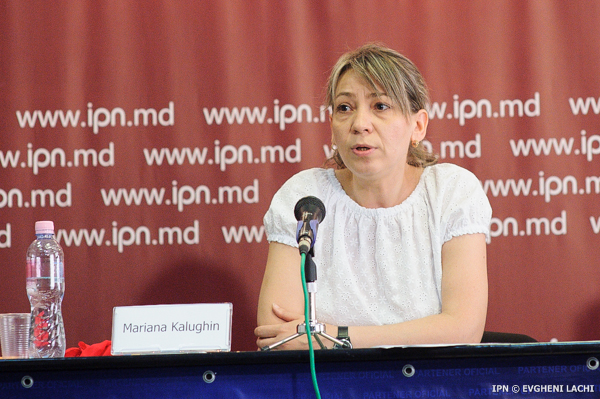
Particular provisions of the bill on the prosecution service limit the rights guaranteed by the Constitution, said experts of the Center for the Analysis and Prevention of Corruption (CAPC). In a news conference at IPN, expert Mariana Kalughin said that even if the bill was passed in the first reading, a number of provisions referring to the appointment of the prosecutor general, the hierarchic control of the work of prosecutors and the possibility of challenging the decisions referring to prosecutors should be reviewed.
“As regards the provisions themselves, the principles of transparency, the principles of participation and of making the prosecution bodies more responsible were ensured sufficiently. However, there are a number of provisions to which we have objections, especially those concerning the control that can be exerted by the superior prosecutor on the inferior prosecutors. We consider this is not fully in line with the new appraisal of the Consultative Council of European Prosecutors, which insists that the functional independence of prosecutors should be ensured by law,” stated Mariana Kalughin. She considers that all the provisions referring to the hierarchic control of the activity of prosecutors should be reviewed.
The expert said that such provisions as those referring to the power of the prosecutor to institute disciplinary proceedings, either against prosecution officers or against investigation officers, seem abusive because they distort the conception of assumption of disciplinary responsibility that is provided in a multitude of special acts. “We suggest limiting this power to notification or request to initiate such proceedings,” she stated.
Mariana Kalughin also said that there are provisions that seem less complaint with the Constitution, while one provision even runs counter to the supreme law. These refer to the appointment of the prosecutor general. Under the bill, the candidate is proposed to the Council of Prosecutors by the head of state, but this is not stipulated in the Constitution and this provision can be implemented only after amending the supreme law. “The fact that the MPs didn’t review the constitutional norms is worrisome as this reveals the insufficiency of authentic will to reform the prosecution service,” she said.
The expert added that the informative note to the bill on the prosecution service contains sufficient argumentation for adopting the bill, but does not refer in particular to the analysis of the level of compliance of the bill’s provisions with the international standards.
The CAPC assessed the bill within the project “Vulnerability appraisal of draft normative and legal documents” that is financially supported by MATRA Rule of Law and Good Governance of the Kingdom of the Netherlands.