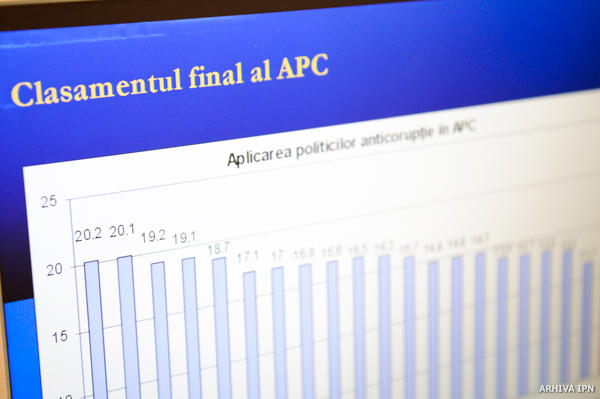
Moldova’s legislation concerning the combating of corruption in the public authorities is good, but at theoretical level only. Its implementation is yet inappropriate. Such a conclusion was formulated by Transparency International – Moldova director Lilia Carashchuk, who, together with representatives of the Center for the Analysis and Prevention of Corruption, launched the report “Monitoring the implementation of anticorruption policies in the central public authorities in 2013”, in a news conference at IPN.
The report contains the results of the implementation of seven anticorruption policies, namely: treatment of conflicts of interest and public ethics; declaration and control of incomes and property; quality of websites; transparence and responsibility in managing public finances; functioning of the petition system; internal corruption prevention mechanism, and quality of hotlines in 20 central public authorities.
The legal framework in 2013 was strengthened. A number of laws were adopted to ensure the independence of judges and to allow extensively confiscating the property earned by acts of corruption and testing the integrity. Criminal responsibility was instituted for unjustified enrichment, the fines for acts of corruption were increased and the ban on holding public posts for those sentenced for acts of corruption to up to 15 years in jail was extended. However, there are shortcomings and omissions that hinder the good implementation of policies in the field.
According to the authors, in general the monitored public authorities in 2013 made effort to ensure the implementation of anticorruption polices. Compared with the previous year, the authorities made progress in applying such policies as declaration of incomes and property, treatment of conflicts of interest, promotion of ethical norms, quality of websites, and functioning of hotlines.
The best results in implementing anticorruption policies were achieved by the Ministry of Economy, the National Anticorruption Center, the Ministry of Justice and the Customs Service, while the poorest ones by the Ministry of Culture.
The study authors propose ensuring the continuous familiarization of persons in charge and employees with the legal framework in the field, improving communication and experience exchange on the implementation of policies, and increasing the responsibility of managers of central public authorities.
The study was supported financially by Soros Foundation Moldova within the Good Governance Program.