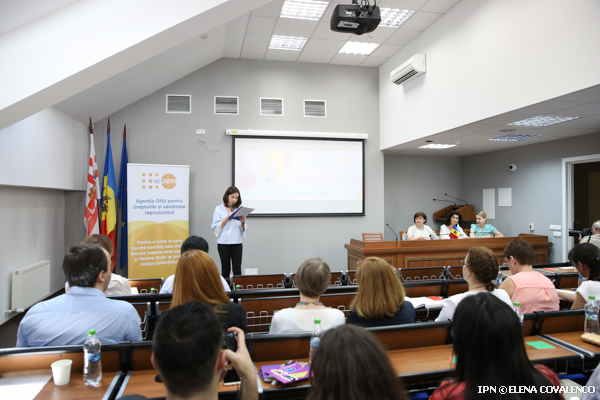
Family planning is one of the basic human rights. Each person and each couple has the right to freely decide the number of children they want to have, the interval between pregnancies, the moment of a pregnancy and if they want to have children. On the occasion of World Population Day that is annually marked on July 11, the Ministry of Health, Labor and Social Protection, in concerti with the United Nations Reproductive Health and Rights Agency (UNFPA Moldova), sensitized the public to important aspects of population development, IPN reports.
Minister of Health, Labor and Social Protection Svetlana Cebotari told a news conference that the family lays the foundations of a healthy and prosperous society, while a family with healthy children means welfare for the country. In Moldova, most of the women who want to avoid a pregnancy do not use safe family planning methods. Only 1/3 of these use modern contraceptive methods and only 14% use traditional contraceptive methods.
The minister noted that each seventh man considers family planning is the responsibility of women. “There are yet many myths that should be done away with. The population should be correctly informed. Each person should have access to information, counseling and family panning of a high quality, including modern contraceptive methods. We call on society to break the stereotypes that persist in our minds and are present in our life,” stated Svetlana Cebotari.
According to the UNFPA Representative to Moldova Rita Columbia, there are yet many women in the world who struggle for their right to have access to modern contraceptive methods. Sometimes it is a life and death struggle. Access to information should be ensured since school, not only when women reach the reproductive age.
“17% of the women in the Republic of Moldova are not appropriately informed and are in the situation when they do not want a pregnancy, but do not possess sufficient information about all the contraceptive methods. This creates impediments in their daily life,” stated Rita Columbia.
According to UNFPA statistics, 17% of the women of reproductive age in Moldova do not have contraceptives even if they do not plan a pregnancy. The need for such means is more acute among young women, poor women and women from rural areas.