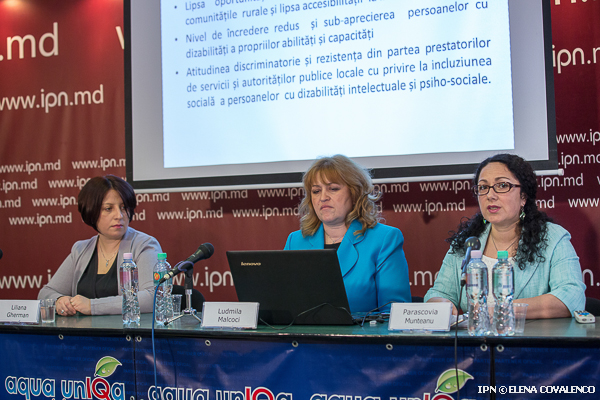
Over 60% of the persons with disabilities have incomes that do not cover at least the costs of food and bare essentials. Two-thirds of the persons with disabilities feel themselves isolated from the rest of the community and only 13% are employed. At the same time, 63% of those questioned do not want to look for a job because they could lose the state benefit. The data are contained in the sociological study “Social inclusion of persons with disabilities” that was presented in a news conference at IPN.
Keystone Moldova executive director Ludmila Malcoci said the study analyzes the changes that occurred after the ratification of the UN Convention on the Rights of Persons with Disabilities in 2010. “This research is important through its theme and I want to note that during the last 30 years, no such a study of the quality of life of persons with disabilities had been carried out. The research can help the Government, the local public authorities to develop national and local policies based on monitoring,” stated Ludmila Malcoci, noting that the persons with disabilities represent 5% of Moldova’s population and it is very important to know about the quality of their life.
Some 54% of those surveyed said their life is worse or much worse than in 2010. Compared with the general population, the number of persons with disabilities who said that their incomes do not cover the basic necessities is two times higher. Two-thirds of the persons with disabilities survive owing to the assistance provided by the family. One-third of those polled said they are helped by no one.
The study shows that 88% of the persons with disabilities cannot afford a vacation with the family once a year or to change the older furniture and domestic appliances. Asked about the measures that need to be taken to improve their quality of life, 91% of those interviewed said the social welfare should be increased, while two-thirds consider jobs should be created for them.
Some 60% of the respondents said they go shopping at least once a week, while 28% go to visit the relatives once a week. They explained that the persons with disabilities do not take part in the public life of communities because there is no one who could help them move. The poor accessibility of roads is also an impediment.
84% of those surveyed said they voted in the presidential elections. Each fifth person of those who didn’t vote explained that the polling station is inaccessible or they could not travel to it. The study reveals that the persons with disabilities do not even know about the possibility of voting at home, with the help of the mobile ballot box.
The study “Social inclusion of persons with disabilities” was conducted by Keystone Moldova with financial support from Soros Foundation Moldova. The field research was carried out between last December and this January and covered a sample of 1,206 persons with disabilities older than 18 from 1,107 communities and 99 residential and placement institutions.