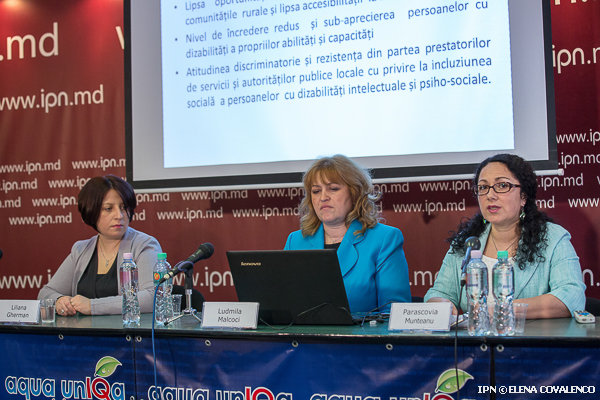
The level of social inclusion of persons with disabilities continues to be low. According to a study carried out by Keystone Moldova, only 43% of the surveyed disabled persons said they consider they are fully integrated into the community, while the rest said they are partially integrated into, partially isolated or fully isolated from the community, shows the sociological study “Social inclusion of persons with disabilities” that was presented in a news conference at IPN.
Keystone Moldova programs coordinator Parascovia Munteanu said a rather high number of persons with disabilities continue to live in residential institutions. The psychical-neurological residential institutions now house about 2,200 adults. A large part of the persons with intellectual and psychosocial disabilities spend a lot of time in psychiatric hospitals. “Not many of them access community services and they spend practically their whole social life inside these institutions,” stated Parascovia Munteanu.
The shortage of funds for developing social services at community level is another obstacle to the social inclusion of persons with disabilities. Among other barriers are the discriminatory attitude to the persons with disabilities, especially those with intellectual and psychosocial disabilities, and the low level of confidence in the own forces. “A lot of persons with disabilities do not have the courage to take part in events owing to discrimination and stigmatization,” said Parascovia Munteanu.
The absence of opportunities for spending free time and the limited access to public institutions prevent many persons with disabilities from taking part in events staged in the community.
The study “Social inclusion of persons with disabilities” was conducted by Keystone Moldova with financial support from Soros Foundation Moldova. The field research was carried out between last December and this January and covered a sample of 1,206 persons with disabilities older than 18 from 1,107 communities and 99 residential and placement institutions.