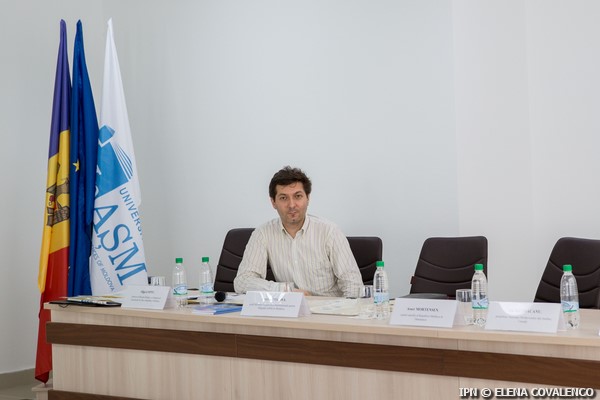
In the Republic of Moldova, research is one of the least remunerated fields. Most of the researchers who carry out high-quality studies do it mainly out of pleasure. Research is not a place where one can become involved and this does not give a stimulus for the people to continue to have interest, said scientific researcher Dorin Lozovanu, president of the Association of Geography and Ethnology of Moldova, IPN reports.
Dorin Lozovanu is the researcher who, during half a year, collected about 150 maps whereby he analyzed the ethnic evolution of the Republic of Moldova and of the Moldovan diaspora during the past 200 years. His activity was financially supported within a foreign project. The works were presented in an exhibition on June 29. Speaking at the end of the international conference “Ethnic communities and diaspora in space and time” in the evening of June 30, Dorin Lozovanu said the state does not invest enough in science and research.
“The remuneration is insufficient. There is a lot of work, but the financing is too small. Probably not the work, but rather the process of printing and presenting the materials is expensive. It is harder to get financing for some of the areas that do not represent priorities for backers. There are speculative areas for which financing can be obtained easier,” said Dorin Lozovanu.
In the same conference, head of the Bureau for Diaspora Relations Olga Coptu admitted that during the last few years no money has been allocated from the state budget for studies of ethnic groups and the composition of the Moldovan diaspora. The data of the research conducted by Dorin Lozovanu will be used to formulate public policies.
“The realities of the last few years, as regards the ethnic communities and the diaspora, have changed and the data we possess are sporadic. These recent date represent more than we expected and will be used as points of reference not only by us, but also by many institutions I think. We lacked these data. We must think up a mechanism for making these data public,” stated Olga Coptu.
An exhibition entitled “Ethnic communities and diaspora in space and time”, with Dorin Lozovanu’s works, was mounted at the Museum of Ethnography and Natural History” on June 29. The exhibit showed that the structure of the ethnic groups in southern Moldova underwent essential changes during the past 300 years. Significant ethnic communities disappeared and were replaced by others that also disappeared and are now substituted by others. At the same time, the communities in the central and northern parts of the country demographically remained practically the same.