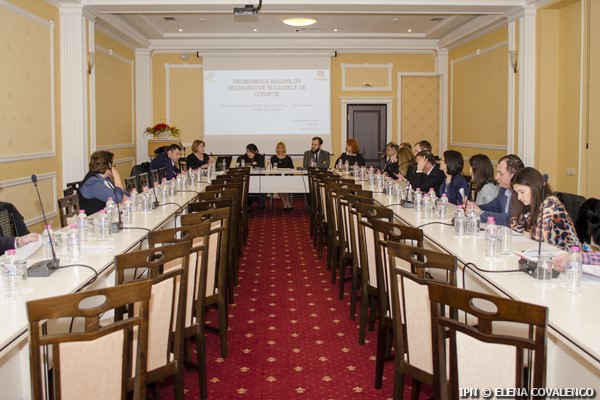
About 100 judges, prosecutors, prosecution officers and lawyers were trained to implement restorative measures in cases of corruption. Within the courses taught in the course of 2015, these learned how to eliminate the consequences of corruption. According to the head of the Center for the Analysis and Prevention of Corruption Galina Bostan, the courses were held within a project financed by Soros Foundation Moldova, IPN reports.
The Center’s head said the courses were built on a study showing that Moldova has sufficient instruments to eliminate the consequences of corruption. “Based on this idea and taking into account the fact that these measures in Moldova are not applied, we reached the conclusion that besides the absence of will, there are also problems related to the implementation of the legislation and lack of knowledge. We thus decided to organize such courses,” she stated.
Galina Bostan explained that the restorative measures include special confiscation, extended confiscation, annulment of contracts that were signed as a result of acts of corruption, the possibility of the state to repair the damage done to it when an act of corruption is committed.
The courses were staged by the Center for the Analysis and Prevention of Corruption in cooperation with the National Institute of Justice, with financial support from Soros Foundation Moldova.
According to Galina Bostan, the Center’s experts drafted a bill to contribute to stimulating the implementation of restorative measures in cases of corruption and to adjust the legal framework so that it favors the persons who suffered damage as a result of an act of corruption.