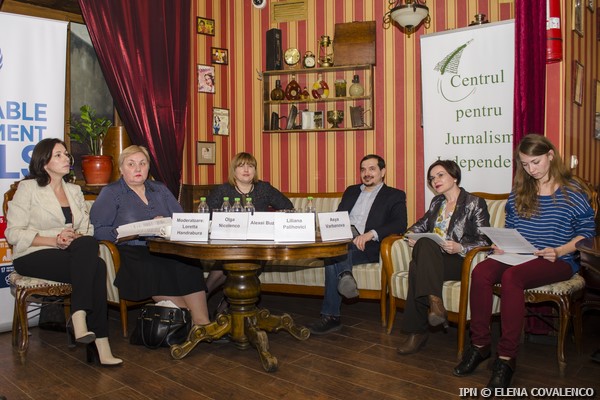
The women are underrepresented in Moldova’s Parliament. These represent about half of Moldova’s population, but in the legislative body they make up only approximately 20%. Balanced representation in the administrative bodies should be ensured in a democratic society. The issue was discussed in a new press club meeting organized by the Independent Journalism Center. This centered on the bills concerning gender quotas in executive posts and on party lists that are debated in Parliament, IPN reports.
Deputy Speaker of Parliament Liliana Palihovici said there are now two bills on the women’s participation in the political life in the legislative body. One of them amends the Election Code and institutes a women’s quota for parties’ lists of candidate. The second introduces punishment for sexist language and rules concerning the covering of subjects related to women by the mass media. “The bills also contain requirements for the Government and Parliament as regards the women in executive posts. A quota of 40% is instituted for the Cabinet,” she stated.
Chief technical adviser at UN Women Asya Varbanova said that at world level the women entered politics at a rather low pace. During the last 20 years, the quota in foreign Parliaments doubled, but it rose only from 11% to 22%. “If we ask ourselves how long it will take to ensure gender parity without doing something, we can determine that this will take 47 years. So, we should ask ourselves if we want to wait for 47 years for things to happen or we want to do something in this regard,” she stated.
According to Asya Varbanova, the quality of governance is better if more women are involved in politics. “An international study shows that corruption in the countries where the women are represented to a greater extent is lower in level. The women take better financial decisions and these take into account the whole population. Democracy is not possible if we do not listen to the voices of all the members of society. Furthermore, the men and women have the same rights and Moldova signed a number of conventions and can fulfill the commitments by adopting laws,” said the technical adviser.
Gender problems expert Olga Nicolenco said the ignoring of the female intellect has a negative effect on society. In 2009, the women in Moldova’s Parliament represented 26%, but now only about 20%. “There is enough intellect among our women, but this is not put to good use. I, as a citizen, am very dissatisfied with the fact that the women’s mind and experience are not used to develop my state. I’m sure that we will live better if we have more women in administrative posts,” she stated.
According to the expert, the state does not honor its commitments in this regard. The authorities promised that in 2015 we will have a women’s quota of 40% in local councils, of 25% in district councils, of 25% among mayors and of 30% among MPs, but nothing was done yet.