Moldova's Jewish community is seeking a memorial status to the monument of the victims of Nazi repressions located on Calea Orheiului Street in Chisinau. But the municipal architects seem to face a dilemma – should the statue be simply furbished up or reconstructed altogether. “We don't care about the technical issues, it is important that this monument continues to exist. Two or three years of empty words more and that monument could disappear”, said Alexandr Bilinkis, a leader of the Jewish community, today at a meeting at the Ministry of Culture, Info-Prim Neo reports.
Deputy Culture Minister Gheorghe Postica confirmed the statue was in a miserable state. “Unfortunately, starting with the 90s, the monument has degenerated, its silver plates were stolen by persons who have remained unidentified until the present day”, said the minister. At a 10 million lei ($0.79m) budget for 2010, the Ministry cannot afford to even renovate the monument, not to mention rebuilding it, so it opened an account to collect the money.
The meeting participants also discussed the opportunity to relocate the monument since the construction of a huge car shop that started several years ago nearby is limiting the sight of the monument.
Sergius Ciocanu, doctor of architecture, opposes both the reconstruction and the relocation. “Being listed in the Register of State Monuments, this monument enjoys legal protection from the government. If these principles were earlier ignored, this doesn't mean that we should continue doing it. Normally a monument should stay where it was first created, because otherwise we could create precedents and it wouldn't be any easier”, said Dr Sergius Ciocanu.
Frustrated that the talks about the restoration of the monument have been going on for several years now, Alexandr Bilinkis says that it won't matter to the Jewish community and monument's visitors whether it is restored or rebuilt, the only thing what matters is that the monument doesn't disappear.
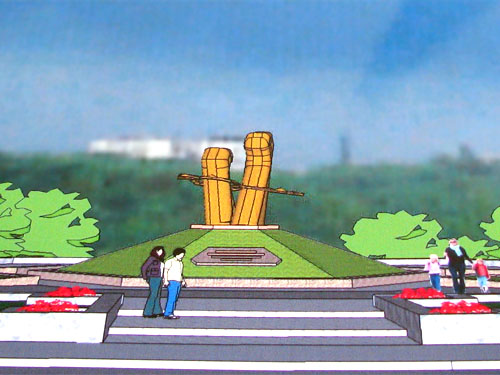
The monument to the victims of Nazi repressions was erected in 1982. It depicts a pair of hands tied with barbed wire arousing from below the ground or, according to the statue's sculpture Aurel David, “from the hell of Nazi repressions”.