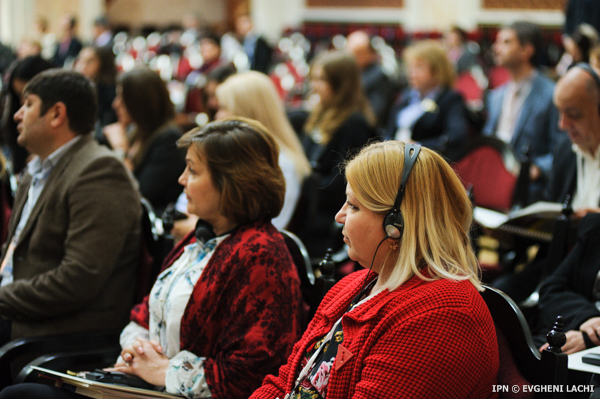
The mass media in Moldova face numerous problems that range from the defective legislation in the field to impediments in work. More than 100 journalists and persons affiliated to the journalistic guild discussed the mentioned problems and formulated recommendations for improving the situation within the first Media Forum staged by the Press Council in Chisinau on October 27-28, IPN reports.
Press Council head Ludmila Andronic said the faculties of journalism really make effort to establish what kind of professionals are needed on the market, but more communication is needed. The university education programs should be adjusted to the needs of the media realities and should be reviewed so that the journalists are trained as reporters specialized in different areas, but who possess knowledge of different types of journalism. The graduates of the journalism faculties should also be able to understand, translate and write texts in a foreign language. More media managers should be also trained.
Journalist Vasile Botnaru said those from media outlets who resort to misinformation managed to make use of it at the given event too. In a workshop held within the Forum, participants proposed that the upright journalists should not greet their colleagues who misinform and should not shake hands with them so as to make them disciplined.
APEL executive director Vasile State stated that making amendments to the legislation without having a complex strategy for developing the audiovisual sector is not right. In the workshop moderated by Vasile State, the participants discussed the serious situation of local and regional broadcasters, noting these should be supported by the state so that they do not disappear.
Talk show moderator Natalia Morari said an anonymous poll showed that two times more journalists admit that the editorial staffs in which they work used manipulation at least once. The definition of ‘manipulation’ should be introduced in the Broadcasting Code. A jury consisting of the most honest persons from the field should be set up to regularly monitor the mass media in Moldova, to examine the most serious cases of manipulation and to monthly compile popular approval rankings of the Moldovan media.
Ion Terguta, journalist and Mir TV Moldova director, who moderated the workshop on publicity, said a new law on publicity is needed as the law passed in 1997 was drafted when there was no broadcasting market and no broadcasters in Moldova. This law does not satisfy the market players. A body for regulating advertising is also needed.
Dumitru Ciorici, the founder of agora.md, said among the subjects discussed in the workshop that he moderated were the protection of the online media from cyber-attacks and the provision of tax concessions for media outlets. More transparency is wanted. The editorial staffs of online platforms should be presented in a special section on the website.
API executive director Petru Macovei and secretary of the Press Council, who moderated the workshop on the print media, said the editors of periodicals have long complained about the discriminatory attitude of “Moldova’s Post Office” against them. This company incorrectly uses a provision of the Law on the Post Office, where nothing is said about the obligation to distribute periodicals. This law should be thus amended. Programs should be promoted to indirectly subsidize the print media distribution services.
Foreign expert Yuri Goligorsky, former editor-in-chief of the BBC World Service, said the enumerated problems are topical not only in Moldova. He called on his colleagues from Moldova to examine how, for example, the Russian TV channel “Dojdi” developed. This channel is now followed online by the largest part of the audience. “If you create a TV channel of a high quality and promote it online, you will be very successful. Don’t miss the Internet revolution,” he stated.
The Media Forum was organized in partnership with the Association of Independent Press (API), the Independent Journalism Center, the Electronic Press Association (APEL) and the Young Journalist’s Center. The event was financed by the Media Program of Soros Foundation Moldova and co-financed by the Council of Europe and East Europe Foundation.