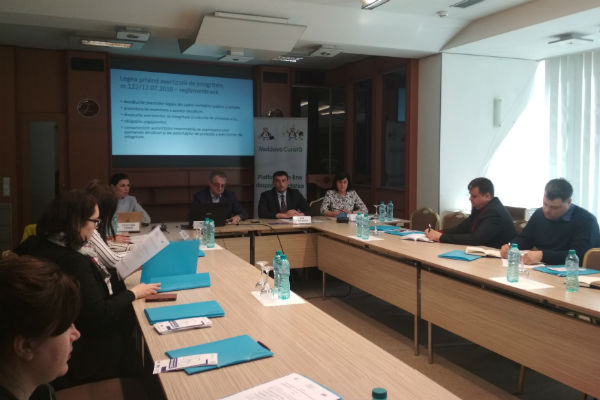
The Law on Integrity Informants is not functional, as whistleblowers continue to face retaliation instead of protection after exposing cases of corruption. Strengthening protection for whistleblowers is crucial in the fight against corruption in a democratic society. This was stated by Petru Macovei, director of the Independent Press Association (API), during a round-table organized by API and the project moldovacurata.md.
“Regretfully, nothing has been done to offer actual protection to people who revealed instances of corruption. We even see scandalous cases where whistleblowers face backlash in the form of criminal proceedings for apparently unrelated things. But anyone with a sound mind can see it’s retaliatory action in response to the exposed corruption in various public institutions”, says Macovei. He says the blame for the failure to offer such protection lays with the National Anti-corruption Center (CNA), the Ombudsman’s Office and other law enforcement bodies.
Cristina Țărnă, former CNA deputy director, recalled that the Law on Integrity Informants was adopted in line with a commitment made to the European Union. The Law regulates exposings of dishonest practices in both public and private organizations, the procedure of examining the claims, and details the rights of whistleblowers and what protection they must enjoy. The authorities responsible for examining the allegations include the CNA and the Anti-corruption Prosecutor’s Office, with the Ombudsman’s Office being designated as the protection authority. A whistleblower may report illegal practices internally, that is to inform a superior, or to the responsible authorities, in which cases he or she must be guaranteed anonymity; or go public and enjoy protection from the Ombudsman’s Office.
Ion Pruteanu, CNA anticorruption education head, said an internal commission has been formed to create a protocol for examining claims from whistleblowers. Pruteanu says it’s important that people know how to report cases of corruption, for example, by calling the CNA helpline, or complaining online, by mail or in person. Pruteanu says rules are in place to prevent leaks from CNA officers.
Olga Vacarciuc, the Ombudsman’s Office secretary, said the instituton hasn’t received a single request for protection from a whistleblower, so the legal protection mechanisms could not be tested in practice. However, says Olga Vacarciuc, the law offers limited means of intervention to the Ombudsman’s Office. “The biggest challenge for us is what intervention to choose so that the whistleblower requesting protection gets enough protection”.
The Law on Integrity Informants was adopted in July 2018 and took effect in November the same year.