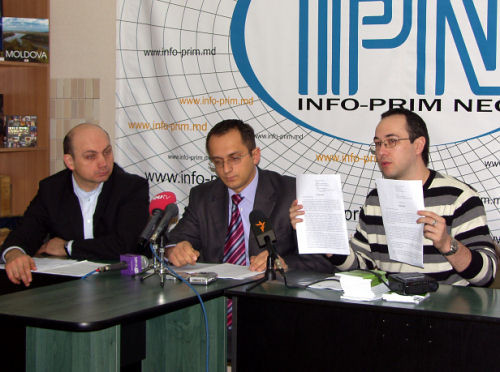
The excessive intervention on the part of the police is the most problematic aspect in ensuring the freedom of assembly. Such a conclusion is contained in a comparative study of the observance of the freedom of assembly in Moldova during 2007-2008, presented at Info-Prim Neo news agency on January 27.
The study carried out by Promo-LEX Association, the Resource Center for Human Rights (CreDO) and Acces-Info Center is a comparative analysis of the new law on assemblies and of the abrogated law. It also describes cases when the freedom of assembly is violated.
After nine months of the coming into force of the new law on assemblies, the civil society ascertains that the local public authorities and courts observe the law in the main. The police commit most of the violations. “No cases of massive violation of the freedom of assembly were reported in 2008 following the actions taken by the mayors’ offices, but there were identified irregularities. The courts also observe the law in general, except several groundless decisions made not according to the law or on the basis of erroneous interpretations,” said Alexandru Postica, the executive director of Promo-LEX Association.
According to Postica, most of the problems concern the place where the assembly is to take place, the limitation of the freedom of expression during assemblies, non-ensurance of pubic order and the assembly participants’ security, prohibition of using technical equipment and of taking pictures. The social costs resulting from the legal cases instituted over the acts taken by the police are another negative factor.
CreDO director Sergiu Ostaf said that the right to free assembly is no more a priority of the European Commission as regards the provision of technical assistance to Moldova from the EU. “This shows that Moldova made certain progress in this direction. At the same time, the European Commission says that the improvements are not steady enough. So, the situation can destabilize any time,” Sergiu Ostaf stressed.
The director of CreDO says that in order to strengthen the results achieved in enforcing the law, it is important that the civil society takes attitude over every violation of the law. Cooperation with the public authorities is another important aspect. By a decision, the Supreme Court of Justice could provide explanations how the law should be interpreted when the situation is unclear.
An advantage of the study is the fact that it can be used by the Prosecutor’s Office to monitor the cases when the police break the law. “It contains sufficient arguments for initiating investigations into cases when the police do not observe the law and the international practice. The study offers well-substantiated support to the Ministry of Internal Affairs in probing its personnel’s acts when ensuring the freedom of assembly,” Ostaf said.
Evghenii Goloshcheapov, the executive director of Amnesty International Moldova, considers that for the freedom of assembly to be strengthened in Moldova, the public authorities and the police should have political will, the police officers that committ violations should be held accountable and there should be organized specialized courses for the policemen that will work in the area.
The study was conducted as part of a project financed by Soros-Moldova Foundation. Over 100 judges and prosecutors as well as representatives of the local public administration have been trained as part of the same project.