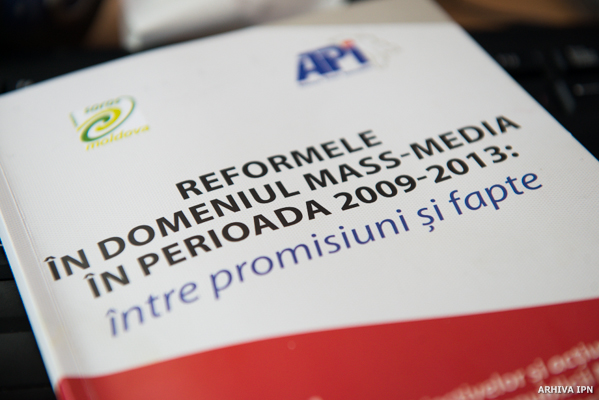
The largest part of the program on mass media for 2009-2013, undertaken by the Government, hasn’t been yet implemented. The Government achieved certain objectives concerning the media, but none of them changed essentially the state of affairs in the mass media sector. Thus, the political energy was wasted on political confrontations, rather than on building an independent media sector that can contribute to strengthening democracy in the country. Such a conclusion was reached by authors of the study “Reforms in the mass media sector in 2009-2013: between promises and facts”.
One of the authors of the study, Petru Macovei, who heads the Association of Independent Press, said that all the governments after 2009 set the objective of ensuring media freedom in their programs, and the commitments fully meet the modernization needs of the Moldovan mass media. No measures to ensure the freedom of the media were stipulated until 2009. Therefore, the mass media’s hopes concerning changes were very high.
In the same connection, another author Nadine Gogu, who is the executive director of the Independent Journalism Center, said that as regards access to information, the journalists meet with the state institutions’ refusal to provide information of public interest or are forced to pay certain taxes. In many cases, the information furnished by the state institutions is filtered and contains only what is convenient to the functionaries. Many of them do not provide information of public interest without the preliminary consent of the superiors and often refuse to answer the questions put by journalists over the phone.
The authors of the study recommend adjusting the normative framework to the international standards, working out and adopting a legal mechanism for facilitating access to information of public interest, and annulling the official taxes that the journalists must pay for such information. The transparency of the process of granting and withdrawing broadcast licenses should be ensured and the methods of using the frequencies should be monitored periodically so as to avoid tendencies to concentrate the mass media.
Chiril Lucinschi, head of the Parliament’s commission on culture, education, youth, sport and mass media, approved of the work done by the media organizations to make the study. “It’s not right to put the entire blame on the Government. There are also other institutions that bear responsibility. As we are a parliamentary republic, Parliament also plays an important role. Thus, it should be specified who and what commitments has,” he stated.
He added that the votes of at least 51 MPs are needed for adopting legislative initiatives in Parliament. “We must make a difference between the intention of the Government that puts forward the initiatives and the acts of the Parliament that adopts them. If the Parliament’s work is analyzed, it will be clear which parties hamper the fulfillment of these promises,” said Chiril Lucinschi.