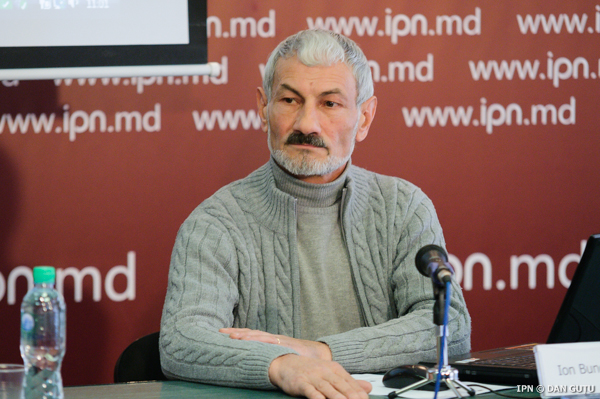
Renato Usatyi is the politician who appeared most often in TV news during the last week of the election campaign - 87 times. He is followed by Vlad Filat with 63 appearances, Igor Dodon and Marian Lupu with 50 appearances each, Vlad Plahotniuc and Vladimir Voronin with 36 appearances each, and Mihai Ghimpu with 26 appearances. The data are contained in the sixth report on the monitoring of the mass media in the election campaign prior to the November 30 elections, which was presented in a news conference at IPN. The report was produced by the Association of Independent Press, the Association of Electronic Press and the Independent Journalism Center within the Civic Coalition for Free and Fair Elections.
Renato Usatyi is also an incontestable leader by the number of appearances in a negative context (29 appearances), followed by Igor Dodon (19), Vlad Plahotniuc (18), and Vlad Filat, Dorin Chirtoaca and Grigore Petrenco (by 7). Vlad Filat appeared 17 times in a positive context, Marian Lupu – 7 times, while Vlad Plahotniuc - 6 times.
Executive director of the Association of Electronic Press Ion Bunduchi said the situation as regards the covering of the activities of state functionaries was a normal one. President Nicolae Timofti appeared 48 times in TV news, followed by Prime Minister Iurie Leanca with 32 appearances and Head of Parliament Igor Corman with 7 appearances.
As to the parties that ran in elections, a clear leader was the PDM with 263 appearances, mainly on Prime TV, Publika TV, Canal 2, and Canal 3, which presented the party in a positive context, and on Jurnal TV, which presented it in a negative context. The PDM is followed by the Party “Patria” with 181 appearances, the PLDM – 146, the PCRM – 117, and the PL and PSRM with 87 appearances each. The Party “Patria” appeared 76 times in a negative context, followed by the PDM – 42, the PSRM – 38, and the PCRM – 16 times. The PDM is a leader by the appearances in a positive context (64), followed by the PLDM (37), the PL (5), the PCRM (4) and the PPRM (4).
The monitoring was performed within a project financed by the U.S. National Endowment for Democracy, the U.S. Embassy in Moldova and East-Europe Foundation with the funds allocated by the Government of Sweden through the Swedish International Development Cooperation Agency and the Ministry of Foreign Affairs of Denmark (DANIDA).