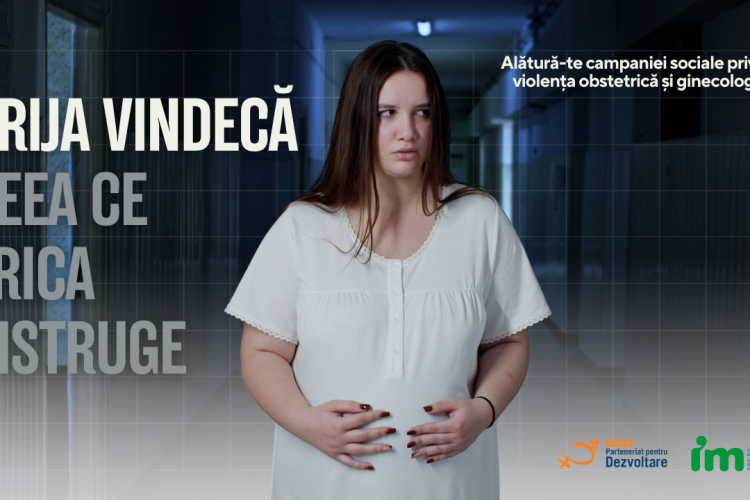
Half of the Moldovan women who gave birth were subjected to a form of obstetric or gynecological violence, the Center “Partnership for Development” (CPD) says in a study that underlay the campaign "Care heals what fear destroys". The event aims to encourage respect and empathy in medical services, IPN reports.
Obstetric and gynecological violence includes procedures performed without informed consent, such as episiotomy, oxytocin administration or use of the Kristeller maneuver. Also, gynecological violence consists of abusive behavior or lack of respect on the part of healthcare workers, such as high tone, shaming, jokes or humiliating comments. Another form of this type of violence is discrimination based on ethnicity, social status, or personal birth-related choices.
According to the study conducted by the CPD, over 60% of women in Moldova have never heard of the term "obstetric and gynecological violence" (OGV). However, about 50% of them said that they experienced at least one form of OGV during childbirth or gynecological consultations. Only half of women recognize OGV as a form of physical, psychological abuse or the result of medical negligence during pregnancy and childbirth.
At the same time, 34% of women underwent medical procedures without informed consent, such as episiotomy, forced administration of oxytocin or the Kristeller maneuver. In addition to these aspects, 14% of women reported verbal abuse, 8% experienced sexual abuse, and 3% were victims of physical abuse.
The data are alarming, said the representative of the CPD Natalia Rezneac. "This year, we have conducted the first study on obstetric and gynecological violence: "No Voice, No Law, No Justice". Unfortunately, the legislation does not clearly define obstetric and gynecological violence, nor for medical malpractice. Thus, a lawyer must determine, depending on the circumstances, which facts of the Contravention or Criminal Code fit the respective case. Depending on the code used, the reporting limit could be up to 2 years from the commission of the act. However, we encourage women to report any incident to the competent institutions or to the hotlines of the Ministry of Health (022 721 010), the anti-corruption hotline (0800 55555) and other services (022 257 333)".
Alexandra, a woman who had traumatic experiences, remembers with pain the loss of her first pregnancy. "I called the ambulance. One of the nurses laughed at me, saying that I didn't know what contractions were. At the hospital, they only gave me painkillers and, in the morning, I lost the pregnancy," said the woman. Being moved to a ward with pregnant women was the hardest part.
Alexandra also said that "during a gynecological check-up, the doctor told me to be patient, with a humiliating attitude. I tried to file a complaint, but I was told that the doctor is protected. I would like the authorities to hear these problems and take action."
Maria Golban describes her first childbirth as "a traumatic experience" at a hospital in the country. "During labor, I was told, 'What are you complaining about so much?' or 'As long as you have to, that's how long you're going to endure.' I was exhausted and didn't know what was going on. My newborn suffered a trauma to the facial nerve, but the doctors did not intervene immediately," related the woman. Maria later gave birth in France, where she was treated "like a princess". "It is crucial to feel that the doctor listens to you, explains and respects your needs. The attitude of doctors can make the difference between a beautiful experience and a traumatic one," said the woman.
Corina, another victim of OGV, remembers her first birth as "marked by humiliation and pain." "I found my balance only thanks to my husband, who was by my side. The attitude of the medical staff was incomprehensible. Young professionals are much more empathetic and should be encouraged to contribute to this system," said Corina.
The impact of OGV goes beyond the moment of birth giving. Affected women can develop post-traumatic stress disorder, anxiety and postnatal depression, which negatively influences the relationship with the child and the partner.
It is the first campaign organized by the CPD to raise awareness and inform about obstetric and gynecological violence. Even though only 6% of the cases are reported, every voice counts. The "Care heals what fear destroys" campaign comes with a guide designed to promote respectful obstetric care and urges women to report abuse.